An Advanced Approach to Software Architecture #
The Control Code project introduces a sophisticated yet easily implementable approach to software architecture. It provides a robust application framework that includes a fast-start template, a set of modular features, an extensible design, and flexible configuration options.
Core Principles #
The framework is built on proven software development patterns, including Transaction Script and Domain-Driven Design (DDD). It employs a layered architecture, allowing applications to evolve efficiently over time.
Additionally, a growing collection of pre-built packages for common subdomains enables rapid extension of application functionality with minimal effort.
Key Benefits #
This approach to software architecture offers several advantages:
- Adaptability to evolving requirements
- Scalability and high performance
- Consistency and reliability
- Low processing latency
- Simplified refactoring
- Cloud-native compatibility
- Comprehensive traceability and monitoring
How It Works #
The architecture follows a structured approach:
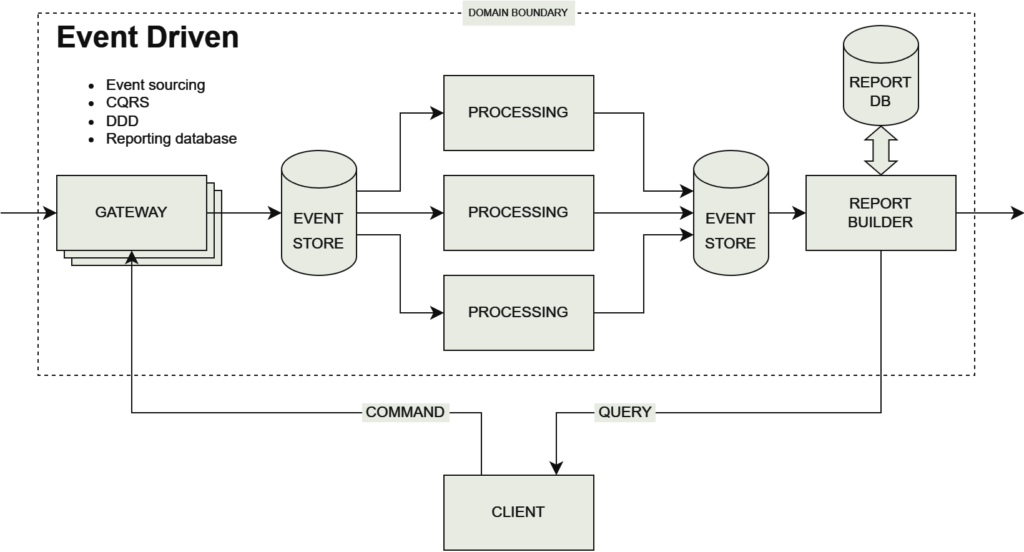
- Gateway – Accepts commands and events from external systems, applies filtering and preprocessing, and stores them in the event store. Supports scalability and high availability through multiple instances.
- Event Sourcing – Commands and events stored by the gateway are processed asynchronously by processing units, which can be stateless or stateful microservices. To handle high throughput, processing units can scale via data partitioning.
- CQRS (Command Query Responsibility Segregation) – Separates read and write operations, ensuring scalability and clear separation of concerns.
- Reporting Database – Handles complex queries efficiently, leveraging data normalization.
- Event Choreography – Synchronizes processes and facilitates seamless communication across different components of the domain model.
A critical aspect of this approach is that domain model state changes and domain events are stored atomically in the event store. This ensures consistency with low latency, eliminating the need for the traditional outbox pattern.
Building a System with This Approach #
Creating a new system using this methodology is straightforward and follows these key steps:
- Define your domain and user needs
- Segment the domain into bounded contexts for microservice implementation
- Use the WebAPI host template as a foundation
- Leverage existing solutions for generic subdomains
- Implement the core domain microservices using a simple transaction script
- Adopt a domain model in microservices where necessary
- Utilize pre-built packages for infrastructure implementation
- Apply the reporting database pattern to manage complex queries separately
- Incorporate event streams and workers for high-load or intensive processing scenarios
With these steps, you can efficiently build a scalable, high-performance system with a modern, event-driven architecture.